
PATIENCE DELIVERS THE BEST RETURNS
TRUST A CAREFULLY CALCULATED PROCESS OVER MERE MARKET WHIMS
By Andro Griessel
01/08/2026
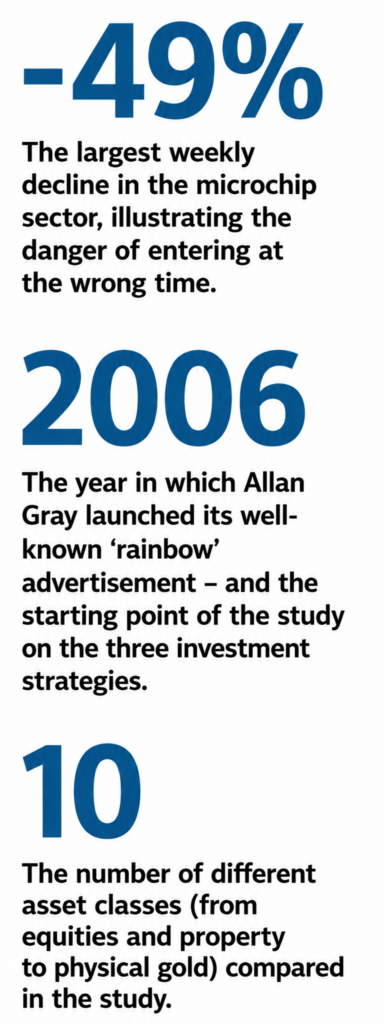
In 2006, Allan Gray launched a new advertisement about people running after a rainbow in the mountains near Riviersonderend, hoping to find the pot of gold at the end of it. They could simply have asked me – I could have told them there is no pot of gold, because it was my hometown and, as a child, we spent plenty of time roaming those mountains. There are lots of baboons, but gold? Unfortunately, none.
The slogan in the advertisement reads: “Some people spend their lives chasing instant wealth, we’ve learned that patience is handsomely rewarded.” We often receive questions from clients about specific asset classes that have performed well in the past (such as gold recently), and whether we should not be investing more in them. This approach is, of course, similar to the people running after the rainbow in the mountains in the hope that, by the time you get there, the pot of gold will still be waiting.
Many people have learned, however, that this is unfortunately seldom how things work in the financial world. Then there are those (and this takes some nerve) who follow the opposite strategy to chasing the rainbow. Let’s call them the ambulance chasers. This is where you strongly believe in the concept of “reversion to the mean”. In other words: If the price of an asset has risen sharply, you believe it must soon fall sharply again, or vice versa. Then, of course, there is a third approach: the more patient approach of someone who constructs a balanced portfolio that can withstand a wide range of conditions, and then sticks with a predetermined process in a disciplined way, regardless of periods of underperformance. Let’s call this the patient approach.
The left-brain-dominant readers will have to forgive the materially oversimplified nature of the analysis that follows, but I do think it makes an important principle very clear. I looked at the year-on-year returns of 10 asset classes in which investors can readily take a position. These asset classes are equities, listed property, bonds and cash (locally and offshore), as well as physical gold and emerging-market equities as a subgroup of equities.
I kept it simple and applied three strategies to the data.
Strategy 1 – Ambulance chasers:
At the beginning of the year, buy the previous year’s worst-performing asset class and hold that position for the full year. Repeat in year 2.
Strategy 2 – Rainbow chasers:
At the beginning of the year, buy the previous year’s best-performing asset class and hold that position for the full year. Repeat in year 2.
Strategy 3 – Patient investors:
Construct a portfolio that can generate the best possible long-term return at the lowest possible risk (the academic literature suggests this is an aggressive balanced allocation), rebalance the portfolio regularly and make small changes to your asset allocation as movements in prices and valuations require from time to time.
Feel free to use the graphic below, titled “Switching strategies since 2006: Growth of R100”, as a reference.
For the period since 2006, the conclusions are fairly clear:
The balanced strategy comfortably performs the best of the three.
It delivers:
- The highest compound return;
- The lowest volatility;
- The smallest decline from a previous high; and
- The highest percentage of positive years.
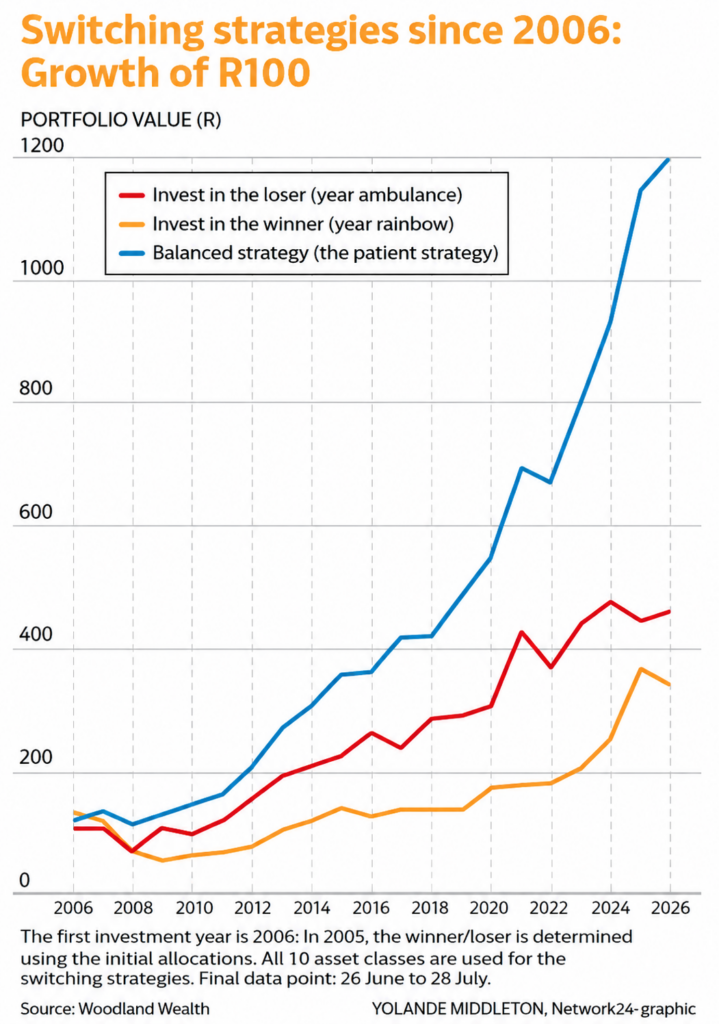
Between the two “switching” strategies, the strategy of buying the previous year’s losing asset classes still performs better than buying the previous year’s winning asset classes (which is what most people intuitively want to do), but neither strategy comes close to the balanced fund.
Now that we have hopefully put the switching idea to rest, the question naturally remains: How does one become the patient investor Allan Gray refers to in its advertisement? If we look at the characteristics of the best investors, a few stand out.
Emotional self-control
Successful investors are not without emotion, but they do not allow fear, greed and group pressure to influence their decisions. Temperament is often more important than sheer intelligence, which comes as a great relief to the writer.
Independent thinking
Exceptional investors often reach conclusions that differ from the consensus – but they do not disagree merely for the sake of being different. The challenge is this: By the time that conclusion is proved right, there are usually quite a few people who were part of the decision. When it turns out to have been too early or wrong, there is little doubt about whose ridiculous idea it was to begin with. If this kind of “loneliness” is a problem for you, you are going to struggle to become an above-average investor.
Howard Marks describes this as “second-level thinking”: It is not enough to know that a company (or asset class) is good. You also have to ask yourself whether everyone already knows it and whether the share price (or asset class) may already reflect excessive optimism.
Intellectual humility
The best investors have strong convictions, but remain acutely aware that they can be wrong, and at times will be wrong. Charlie Munger always said, “invert”, or make the opposite argument to the one you think is correct. It is important not to become “married” to your ideas and to be willing to change your opinion when new evidence emerges. Confidence enables an investor to pull the trigger on a new idea, but humility prevents that confidence from turning into recklessness and arrogance.
Patience and a long-term approach
Successful investing often involves long periods during which you should actually do very little. Excellent investors wait both for the right opportunity and for sufficient compensation for the risk they are taking. One of the asset-management industry’s Achilles heels, in my view, is that investors can no longer tolerate short-term underperformance and therefore abandon their asset managers at the most inopportune times. Being early with a good idea often makes the idea look wrong. A current example of patience is Berkshire Hathaway’s enormous cash position because of the lack of opportunities in the US. Patience, however, should not be confused with stubbornness. A long investment horizon cannot rescue a poor asset bought at an indefensible price.
A disciplined approach to risk
Successful investors do not regard risk as mere price fluctuations. Their biggest concern is the permanent loss of capital or the possibility that they may be forced to sell an investment at the wrong time, when the proverbial music stops and everyone tries to squeeze through the same tiny door. A classic example of this is currently playing out in the semiconductor manufacturing sector, with one-week declines of 36% (Micron Technology), 20% (Taiwan Semiconductor), 49% (SK Hynix) and 36% (Samsung Electronics). Disciplined investors think carefully about that tiny door and tend to stay out of those “rooms”.
The crux of the matter? The long-term winner is usually not the one who switched around the most, but the one who chose a good plan and stuck with it for long enough. The mountains of Riviersonderend may not have gold, but they do teach you something: If you run after every new rainbow, you are probably more likely to come across a baboon than a pot of gold. In the investment world, it is not much different.
Andró Griessel is the chief executive officer of Woodland Wealth. Contact him at andro@woodlandwealth.co.za.
Although all possible care has been taken in the preparation of this document, the factual correctness of the information contained herein cannot be guaranteed. This document does not constitute advice and anyone who intends to take any financial action based on this document is strongly advised to first consult with his/her personal financial advisor. Woodland Wealth is an authorized financial service provider with FSP no. 5966.