
‘A PUBLIC BENEFIT’
THIS GENERATION CAN MAKE A DIFFERENCE
By Cassie Carstens
04/07/2026
It is only much later in life that one begins to appreciate wisdom. My grandfather always said, time will tell. I am referring here to the phenomenon known as “The Great Wealth Transfer”. Over the next few years, millions of people (mostly young) will become the recipients of the largest transfer of wealth the world has ever seen. It is fascinating to study how this came about (see graphic below):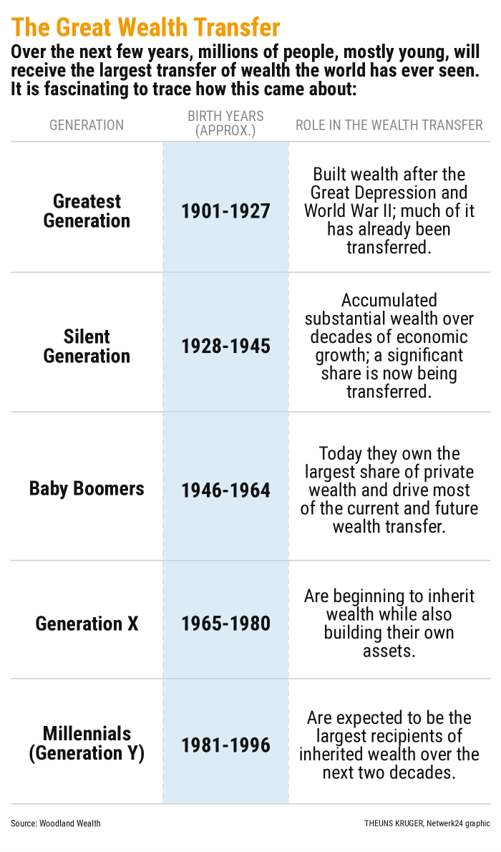
The figures behind this are still being bandied about rather loosely, but a 2025 study by financial services provider UBS produced the following chart. A few notes on the graphic (see below):

- Horizontal inheritance refers to transfers of wealth from an older to a younger generation.
- Vertical inheritance refers to transfers of wealth between spouses.
If we assume that the spouses are roughly in the same age group, that wealth is also ultimately headed to a younger generation. (Source: UBS Global Wealth Report 2025)
There is an Italian saying which, loosely translated, goes: “from the stables to the stars, and back to the stables in three generations”. Time will tell whether the recipients of this wealth will use their “overnight millionaire or billionaire” status wisely. We have written before about the concept of a “family wealth plan”, which is about equipping the recipients of the wealth financially and emotionally so that they do not end up back in the stables.
South Africa does not appear on the adjacent chart, but the same situation is unfolding locally. Fortunately, this has been well known for some time, and product providers have done exceptionally good work with advisers to develop excellent solutions that facilitate this wealth transfer in a tax-efficient manner. That, however, is not the purpose of this article.
What if you would rather leave your wealth to charity?
More and more people are considering leaving a portion of their estate to a Public Benefit Organisation (PBO). However, the fine print of the Income Tax Act means that pitfalls can easily affect an estate’s liquidity if the assets are not specified correctly.
- 20% – The estate duty that applies to bequests to trusts, children or domestic workers on amounts between R3.5 million and R30 million.
- 25% – The maximum estate duty rate SARS levies on the portion of an estate exceeding R30 million.
- 5m – The basic exemption (primary abatement) to which every person’s estate is entitled before any estate duty is calculated.
Very little airtime is given to an innovative way of reducing the size of your estate: making a bequest in your will to an approved Public Benefit Organisation (PBO). In more and more conversations with clients, they mention this intention, but are completely unaware of how the mechanism works. Clients begin considering it when their children are financially independent or when they have no family members they wish to nominate. Just a quick reminder:
- Bequests to a spouse qualify for the section 4(q) estate duty deduction, as well as capital gains tax rollover relief.
- Bequests to a trust, children, relatives, domestic workers and so forth do not qualify for an estate duty exemption. Estate duty of 20% applies to amounts between R3.5 million and R30 million, and 25% to amounts above R30 million.
In the latter case, assets that have appreciated in value are deemed to have been disposed of at death, and capital gains tax is also levied. Grandfathers, grandmothers and parents are, of course, entirely free to decide what to leave to whom and how much. But they also have an opportunity, as a generation, to make one of the greatest differences imaginable to the financial position of a Public Benefit Organisation. These are institutions that must battle every day to raise enough money simply to stay afloat. As with everything in financial planning and tax, this is a relatively simple concept with many ramifications. Before changing your will, you should obtain proper advice, especially on the wording and on whether the PBO is in fact approved and qualifies for such a bequest.
Another option is to establish your own approved PBO during your lifetime, appoint a competent board, and nominate it in your will. As a general rule, capital gains are also exempt from tax when a bequest is made to a PBO, but the wording of your will is critical here. Paragraph 62 of the Eighth Schedule to the Income Tax Act deals with this issue, but it remains a grey area.
For example, Uncle Piet has a R20 million unit trust investment with R10 million in accrued capital gains, a property worth R10 million, and debt of R3 million. His will states: “My residual assets must be realised and bequeathed to ‘We offer Help’, PBO number XYZ.” Section 16.2.2 of SARS’s Comprehensive Guide to Capital Gains Tax, Issue 9, makes it very clear that specific assets must be named before the deceased person can also benefit from the capital gains tax exemption. A more precise description would be: “I bequeath my Allan Gray unit trust investment to ‘We offer Help’, PBO number XYZ.”
The first obvious problem is that these bequests must not create a liquidity problem in the estate when taxes have to be paid – or worse, force the sale of a property when that was never your intention. In the example above, Uncle Piet still owes the bank money, and SARS appears to interpret the position as follows: if liquid investments must be used to settle debt, the investment must first be realised, capital gains tax must be paid, and only the remaining cash can be bequeathed to the PBO, with no capital gains tax exemption.
One way to handle this correctly is to create two investments and calculate the likely provision required for the debt, executor’s fees, capital gains tax, and so forth. The will could then be worded as follows: “I bequeath my Allan Gray unit trust investment 1 to ‘We offer Help’, PBO number XYZ, and investment 2 must form part of the residue of my estate to cover costs and taxes.”
Investments 1 and 2 are then held separately for these purposes. A second, very important consideration is to make sure that the PBO to which you wish to bequeath assets is permitted to hold those assets. A PBO could, for example, inherit someone’s shares held on an offshore platform, while its policies or founding documents may prohibit it from holding such direct offshore investments. In such a case, there is a risk that the capital gains tax exemption will also not apply, because the PBO may receive only the cash proceeds net of tax.
The solution is to use a product structure that the PBO is permitted to hold, thereby preserving the capital gains tax exemption while still giving effect to the client’s investment intention. Simple, but critically important. This article may leave a spendthrift heir-in-waiting with a bead of sweat on the upper lip. Time will tell whether grandfathers, grandmothers and parents will make PBOs partial or full beneficiaries under their wills, without, of course, being unfair to their children, grandchildren and family. The difference this generation can make to the financial future of a PBO is extraordinary.
Cassie Carstens is a Certified Financial Planner at Woodland Wealth (Pty) Ltd and can be contacted at cassie@woodlandwealth.co.za.
Although all possible care has been taken in the preparation of this document, the factual correctness of the information contained herein cannot be guaranteed. This document does not constitute advice and anyone who intends to take any financial action based on this document is strongly advised to first consult with his/her personal financial advisor. Woodland Wealth is an authorized financial service provider with FSP no. 5966.