
RATHER SPOT THEM EARLY
Savings still need room to grow
By Samuel Rossouw
02/05/2026
I recently met with a client who is ready to press the retirement button. In other words, he is about to put down the goose that has laid the golden eggs for the past 40 years (his salary), and from here on, he will be largely dependent on his investments and the decisions made about them. We had prepared for this day for a long time, yet the conversation was still surprisingly intense and nerve-racking. There are several myths about retirement, and it helps to spot them early. If you understand them properly, you can prevent a myth (or two) from becoming your financial nemesis.
Myth #1: When I retire, I need to allocate my funds much more conservatively
The reality is that the moment you retire, your investment term is still long – in most cases, 25 years or more. Growth assets are the only asset class that will protect you against inflation over the long term. In general, however, there is a sweet spot in terms of how many growth assets you should hold (see the graph).
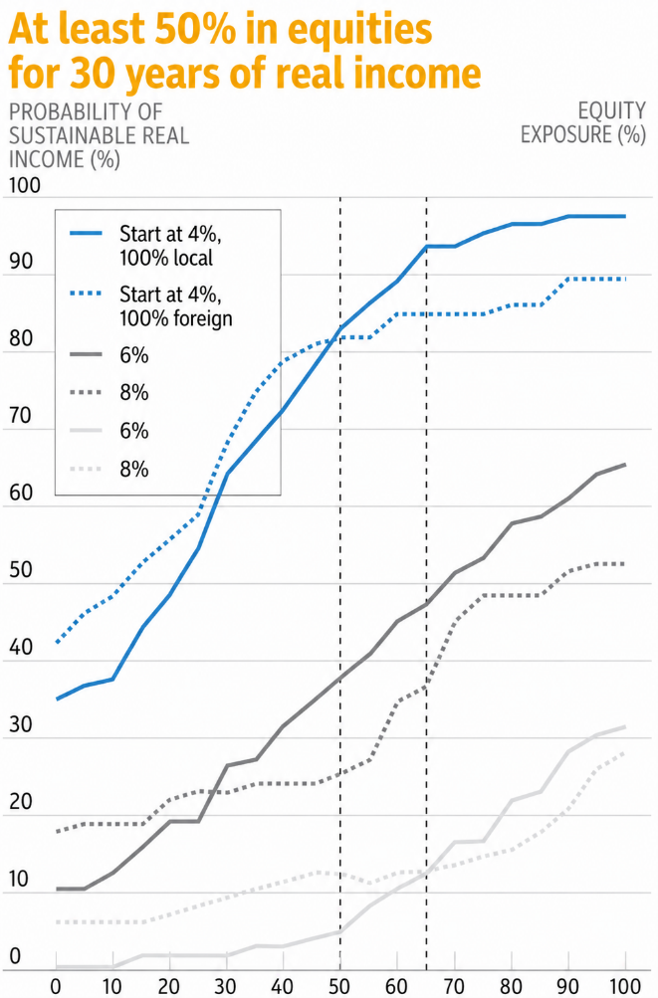
In an unpredictable world, your exposure to growth assets should be at least 50% to have a reasonable probability (80%) that your retirement plan will work (assuming a 4% withdrawal rate). If your exposure to growth assets increases to 65%, however, there is a 90% probability that your income can be sustained in real terms (adjusted for inflation). You may be able to pass matric with 50%, but when it comes to planning, a 50% exposure to equities is very low, and your chance of success will be only 25%.
Myth #2: Get quotations from different advisors before investing my money
With this statement, I am not trying to imply that you should not consult different advisors about your retirement options – that can certainly be valuable. But if you merely request a quotation that only shows the cost of a solution, there is a strong chance that apples are being compared with pears. The fees of passive and/or conservative funds are normally considerably lower than those of active fund managers who allocate largely to growth assets.
Therefore, compare options with similar asset allocations, and compare them after all fees and costs. Also, keep in mind that fund fees can, in any case, change if funds or models are adjusted. Most investment platforms’ costs (administration fees) decrease as investment amounts increase. Your other funds – and even those of your spouse or trust – can also be taken into account when platform fees are calculated. Be clear about the value your advisor adds and the role they play in your planning.
If you receive only an investment statement or summary once a year, the advisor’s fee should be significantly lower than that of someone who conducts a thorough review process of your total finances and is closely involved in your decision-making.
Myth #3: A guaranteed pension is safer because it guarantees my income
There is a wide variety of guaranteed-pension options, and they can differ quite substantially, especially on these points: Annual increases (for example level, inflation-linked, fixed percentage); transfer of pension to a spouse (100%, 75%, 50% and so on of the original income); minimum payment terms, for example 15 or 20 years; and with-profit pensions, meaning pensions linked to the performance of certain underlying funds. The guarantee is therefore the starting income, but the compromise is how the income increases or is sustained.
Consider this, for example: R10 000 per month of income that remains constant loses 55% of its purchasing power over 15 years (assuming inflation of 5.5%). Pensions that are reduced by half when a spouse dies can also have a material negative impact on planning. A product that is being considered more frequently is hybrid annuities, in other words, products consisting of a living annuity and a life annuity, where a portion of an investor’s income is guaranteed, and a portion is subject to market conditions. These products certainly have a place in planning, but the principle that an investor permanently gives up their capital (or access to it) remains a very important consideration.
Myth #4: My house (or beach house) is my biggest asset and must be protected at all costs
The sentimental nature of this asset makes it particularly complicated to use effectively in planning. The unfortunate reality is that, in the absence of meaningful real growth, as well as the generally low potential income rate from rentals, this asset class’s ability to help investors out of difficulty over time diminishes. According to the Global Property Guide’s 2026 survey, the real annual return from property in South Africa is approximately 0% to -2% over the long term. Refer to the table below.
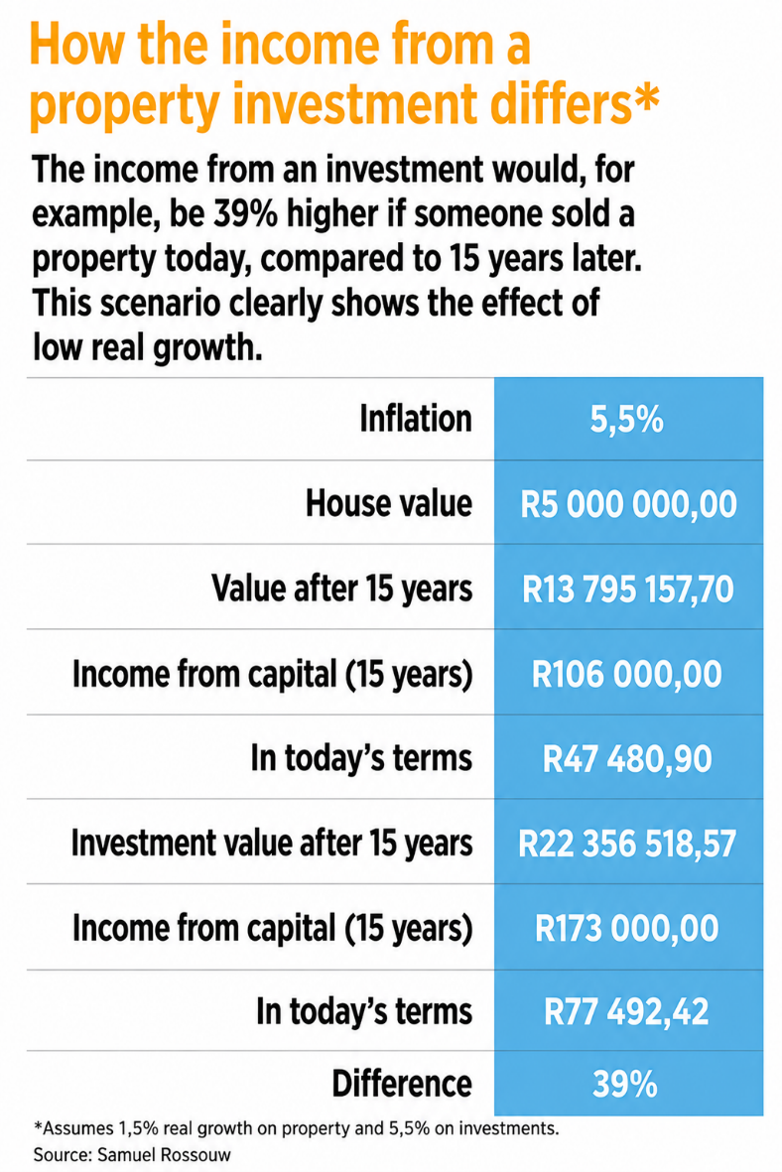
The income from an investment would, for example, be 39% higher if someone sold a property today rather than 15 years later. Naturally, the possible rental of a new property, or maintenance on the existing home, must be taken into account, but this scenario clearly shows the effect of low real growth. (Assume real growth of 1.5% on property and 5.5% on an investment).
In his book, Your Perfect Portfolio, author Cullen Roche refers to the principle that investors should not necessarily aspire to or aim for the highest possible return or the best fund, but should rather be guided by their own needs and goals. If you understand these principles and make decisions with a purposeful plan that will anchor you rather than trip you up, retirement can be an exciting new chapter in your life.
Samuel Rossouw is one of the directors of Woodland Wealth. Contact him at info@woodlandwealth.co.za.
Although all possible care has been taken in the preparation of this document, the factual correctness of the information contained herein cannot be guaranteed. This document does not constitute advice and anyone who intends to take any financial action based on this document is strongly advised to first consult with his/her personal financial advisor. Woodland Wealth is an authorized financial service provider with FSP no. 5966.